

For the latest standardized performance and holdings of Sprott ETFs, please visit the individual website pages: REXC, METL and SETM. Past performance is no guarantee of future results.
Key Takeaways
- Robotics Is Scaling Rapidly: Industrial robot installations have more than doubled over the past decade, while automation expands into logistics, healthcare, defense and consumer applications.
- Rare Earths Enable Performance: Rare earth elements are critical inputs for high-performance magnets, sensing systems, displays and electronics that help robots move precisely, perceive their environment and operate efficiently.
- Humanoid Robots Could Lift Materials Demand: As humanoid robots become more capable and commercially viable, their reliance on rare earth magnets could create an important new source of long-term demand.
- Supply Chain Security Matters: China's dominance in rare earth refining and magnet manufacturing underscores the strategic importance of building diversified, mine-to-magnet supply chains outside China.
The Rise of Intelligent Machines
Factories are becoming smarter, warehouses are more autonomous and robots are increasingly capable of seeing, sensing and acting in complex environments. Behind these advances lies an often-overlooked group of materials: rare earth elements (REEs).
Robotics is poised to bring about the next evolution of AI-led growth: physical AI, in which intelligent machines perceive, navigate and interact with the physical world. Across manufacturing, transportation, logistics, healthcare and the home, Morgan Stanley projects annual robot sales to increase from an estimated 29 million units in 2026 to 1.4 billion by 2050, driving demand for the rare earth permanent magnets that are indispensable to compact, powerful and precise robotic motion. At the end of 2024, the global operational stock of industrial robots totaled 4.6 million units,1 with more than 500K being installed annually and the total expected to reach nearly 40 million units by 2040.2
Figure 1. Growth of the Global Factory Robot Workforce (2014-2024)
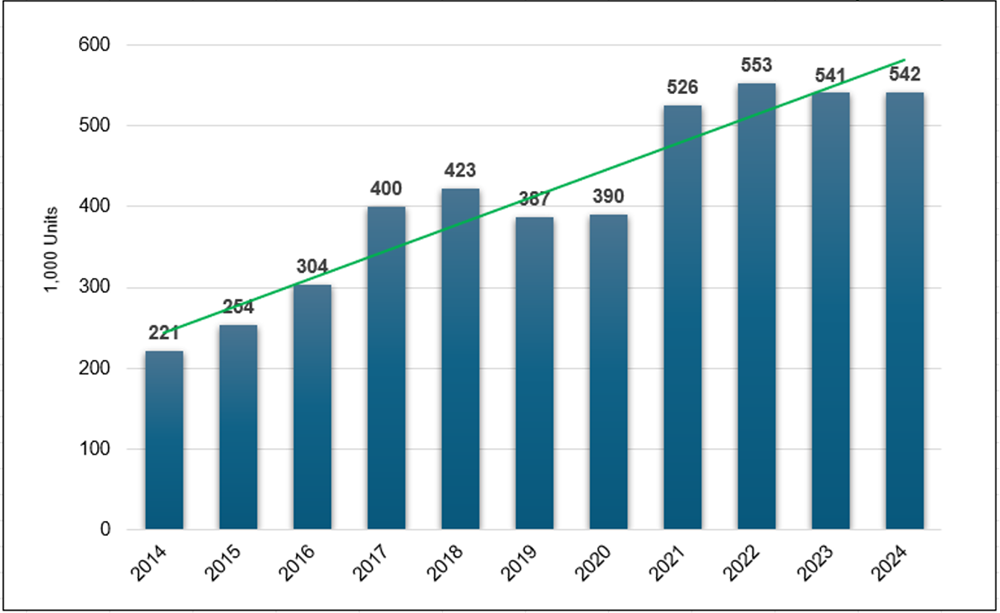
Source: IFR World Robotics 2025 Report.
Modern robots require precision motion, advanced sensing capabilities and sophisticated electronic systems. Rare earth elements enable many of these critical functions, and permanent magnets are essential to robotic motion systems. Some estimates suggest that advanced industrial and humanoid robots could require approximately 1-3 pounds of rare earth elements for the powerful permanent magnets that enable compact and precise movement.
As global automation accelerates, robotics could become an increasingly important driver of long-term demand for rare earths. The sector's projected growth underscores how emerging technologies are creating new, durable markets for critical materials once viewed as niche industrial inputs.
Rare Earths Enable Robotic Performance
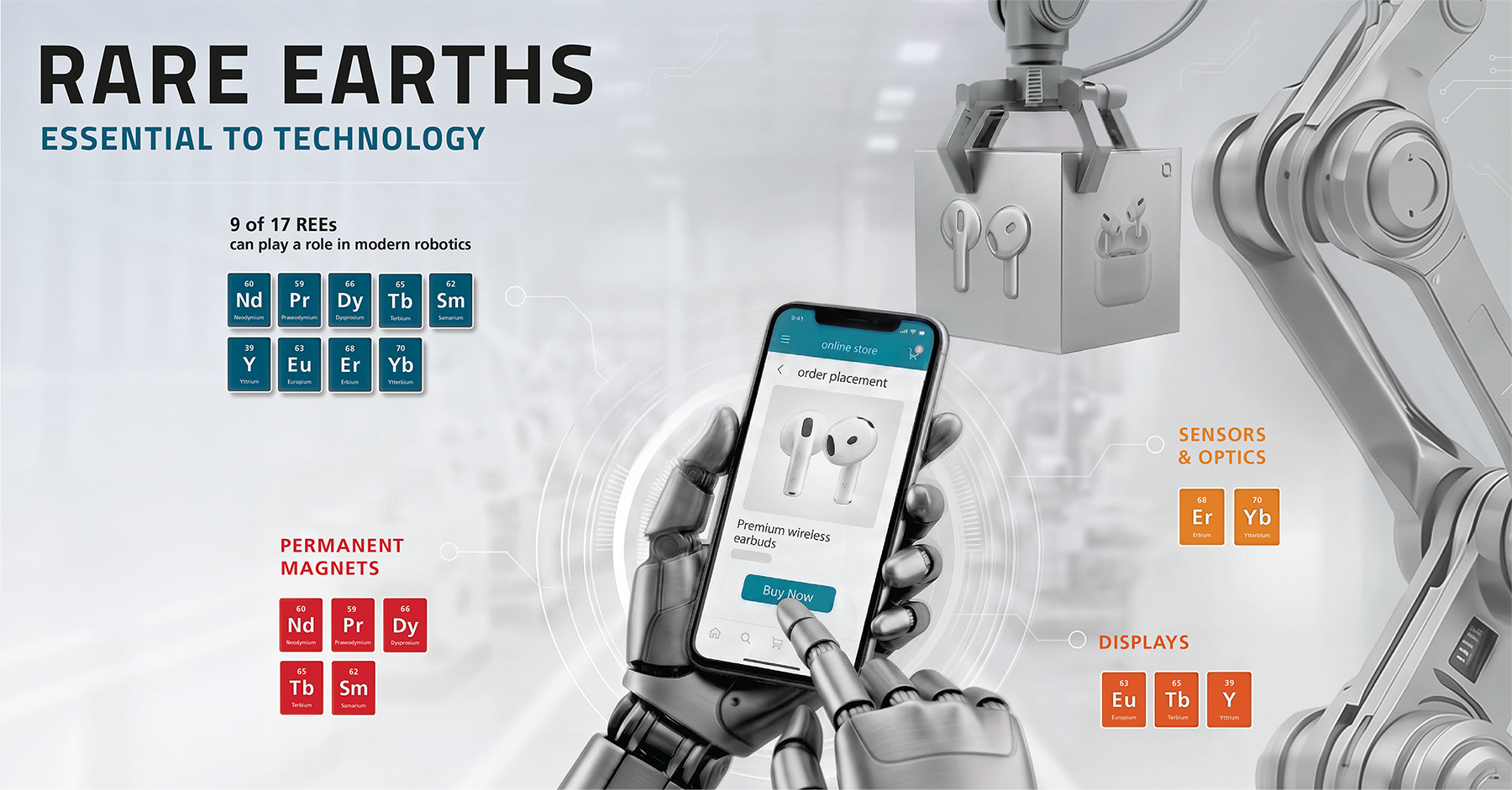
Rare earths comprise 17 elements that are relatively abundant but difficult to process economically. They are characterized by their magnetic, optical and electrochemical properties, which are nearly impossible to substitute. Miniaturization, efficiency and durability often depend on rare earth materials, making them indispensable components of many advanced technologies. Their absence would disrupt the production of many advanced technologies and significantly impair production across a range of industries.
As technologies become more sophisticated and performance requirements grow more complex, the importance of rare earths increases in parallel. The unique characteristics of REEs help engineers overcome physical limitations related to size, weight, power consumption and reliability, enabling systems to deliver greater functionality in increasingly compact and demanding environments.
For example, the Holy Grail of robotics technology is object manipulation, including tasks as simple as picking up a glass of water. As robots become more adept at handling tools, packages and household objects, demand for the rare earth magnets that power their motors and actuators is likely to increase alongside the growing complexity of robotic systems.
Rare Earths Across the Robotic Stack
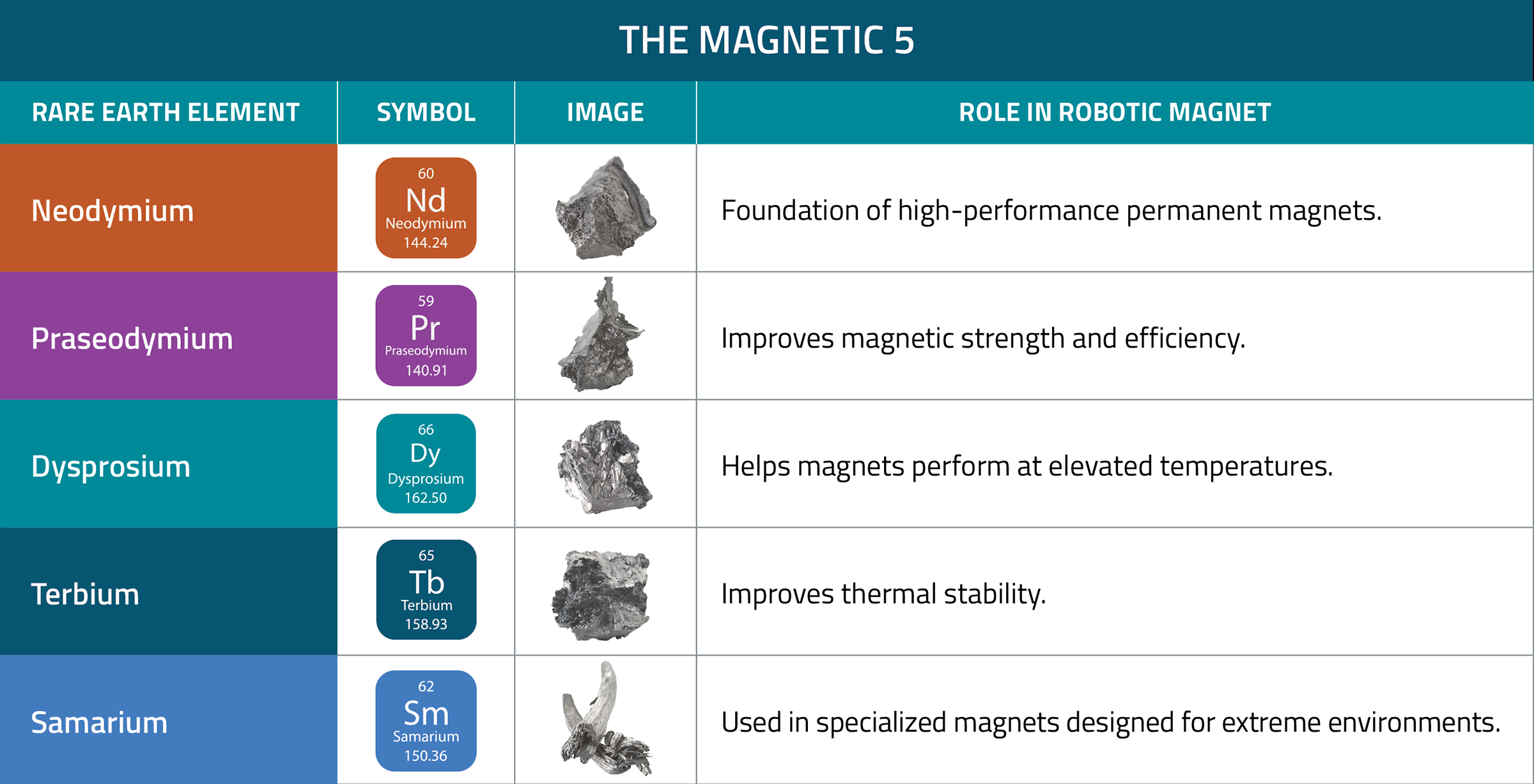
Magnets: Powering Robotic Motion
Robots rely on several rare earth elements to meet varying performance and component requirements. REEs are critical for industrial robots, collaborative robots (cobots), warehouse automation systems, humanoid robots and surgical robots.
Permanent magnets account for more than 80% of global rare earth demand by value, largely because they are essential for the high-performance motors used in robotics and automation.3 A humanoid robot can contain multiple times more magnetic material than an electric vehicle, highlighting the growing rare earth intensity of advanced robotics.
Figure 2. The REEs Used in Robotic Magnets
Source: Sprott Asset Management. Images from Science Source Images.
Sensors and Electronics: Enabling Sensing and Control
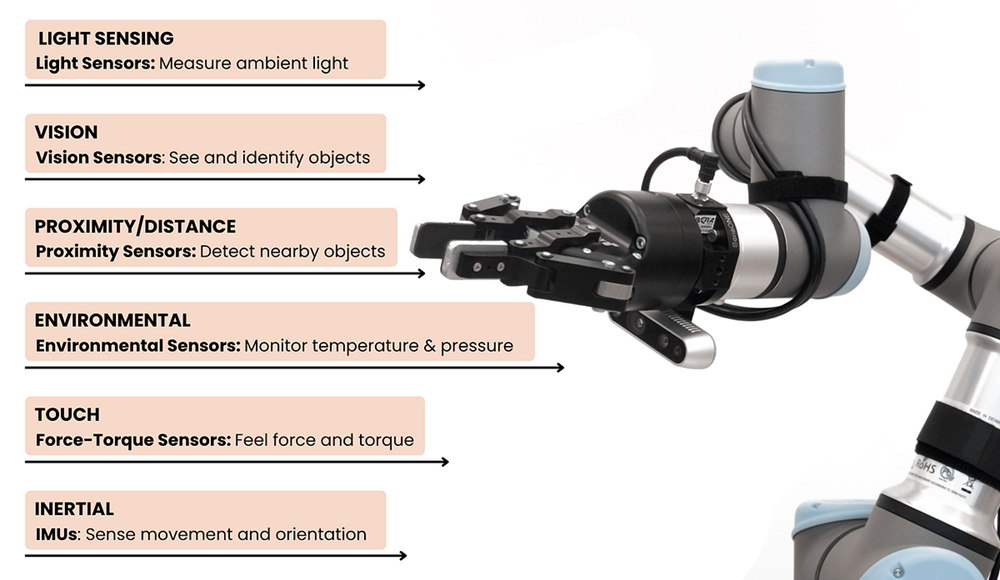
Sensors give robots the ability to see, hear and sense their surroundings, while electronic systems process information and coordinate movement. Rare earth elements support these functions, including ytterbium (Yb), used in fiber optics and navigation systems, and erbium (Er), used in signal amplification.
Advanced sensors allow robots to detect obstacles, navigate environments, build digital maps and perform precision tasks. Contextual reasoning is one of the most important goals on the horizon in robotics development and is crucial for robots to navigate changing environments and respond to external stimuli. Demand across the sensor landscape is expected to continue growing, with proximity and force (torque) sensors seeing particularly strong growth.
Figure 3. Robotic Sensors: What They Do
Source: Botasys.com, Robot Sensors: Types and Applications Unveiled, 7/7/2025.
Displays and Human-Machine Interfaces: Connecting Robots and Operators
Displays and human-machine interfaces (HMIs) are the bridge between robots and people. If sensors are a robot's eyes and electronics are its nervous system, HMIs are the means by which humans monitor, control and collaborate with robots. In many applications, the quality of the interface determines how effectively a robot can be deployed and managed.
Three rare earth elements, europium (Eu), terbium (Tb) and yttrium (Y), are used in certain robotic functions. Europium produces red phosphors and is used in displays and control systems. Terbium produces green phosphors and enhances screen and display visibility. Yttrium provides a stable foundation for the materials that produce the light and color in the display.
Modern humanoid robots commonly feature 40-60 degrees of freedom (DoF), compared with roughly 26-34 DoF in earlier generations.4 More joints, actuators and sensors mean substantially more operational data that must be monitored and managed through sophisticated HMIs.
Robotics increasingly rely on real-time visual feedback. Operators use advanced control displays and monitoring systems. Visual systems support precision manufacturing and quality control. Additionally, there is a growing connection among machine vision, AI and robotics, driven by increasing data requirements for autonomous systems.
Figure 4. Rare Earths in Modern Robotics
Source: Sprott Asset Management. View full infographic.
Robotics Adoption Expands Across Industries
The humanoid robot market is projected to grow from roughly $3 billion today to approximately $38 billion by 2035, creating a significant new source of demand for rare earths.5 The robotics landscape includes industrial robots and service/professional robots.
Figure 5. Humanoid Robot Market Forecast to Grow to $38B (2023-2035)
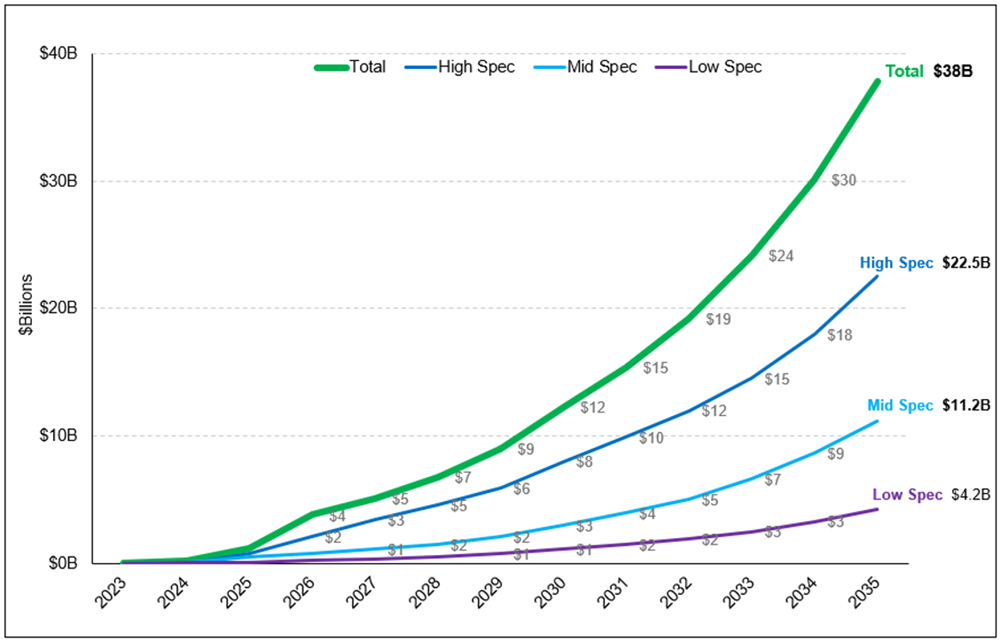
Source: Goldman Sachs Research. High, mid and low spec refer to robot sophistication, from basic functionality to state-of-the-art. Note: Intermediate values are reconstructed from the supplied chart image; 2035 end points match the chart labels.
Currently, the industrial robotics sector has approximately 5 million units, and Asia dominates, accounting for 74% of new industrial robot deployments.6 Service robotics are concentrated in logistics and transportation (52%), hospitality (21%), professional cleaning (13%) and agriculture (10%). While medical robots accounted for only a small share of this total, installations grew by 91% in 2024, highlighting the rapid expansion of healthcare robotics.6
As robots become more capable of navigating complex environments, manipulating objects and interacting safely with people, adoption is expanding into the logistics, healthcare, defense and consumer markets. These emerging use cases are increasing both the scale and diversity of demand for the motors, actuators, sensors and control systems that enable robotic functionality.
Manufacturing
Manufacturing remains the foundation of the robotics industry, but the nature of industrial automation is evolving. Modern smart factories increasingly integrate robots with machine vision, artificial intelligence, predictive maintenance systems and interconnected production networks. Rather than performing a single repetitive task, robots are becoming more flexible and capable of adapting to changing production requirements. This trend is helping manufacturers improve productivity, address labor shortages and enhance product quality while reducing costs.
Warehouse Automation and Logistics
The rapid growth of e-commerce and global supply chains has accelerated investment in warehouse automation. Autonomous mobile robots are increasingly used to transport goods, manage inventory and streamline operations inside fulfillment centers. These systems can operate continuously, improve efficiency and reduce dependence on manual labor in large distribution facilities. Many logistics leaders are investing heavily in robotic solutions to support faster delivery times and increasing order volumes.
Healthcare Robotics
Robotic systems are increasingly being used to enhance precision, consistency and outcomes across a range of medical applications. Surgical robotics allows physicians to perform highly complex procedures with greater accuracy and control, while rehabilitation systems assist patients recovering from injuries, surgeries and neurological conditions. As populations age and healthcare systems face growing resource constraints, robotics is likely to play an increasingly important role in improving patient care while helping providers manage rising demand.
Defense and Autonomous Systems
Defense organizations around the world are investing in robotic and autonomous technologies to enhance operational capabilities and reduce risks to personnel. Autonomous vehicles, drones and unmanned systems are increasingly used for reconnaissance, surveillance, logistics support and other missions in challenging environments. Continued investment in defense modernization is expected to support long-term growth in robotic technologies and the supply chains that underpin them.
Consumer and Service Robotics
Service robots are becoming increasingly common in homes and businesses, performing tasks ranging from cleaning and maintenance to customer service and personal assistance. At the same time, advances in AI, sensing technologies, and human-machine interaction are enabling smarter, more capable and more connected devices. As costs decline and functionality improves, robots are expected to move beyond specialized industrial settings and become a more familiar part of everyday life.
Supply Chains and the Race for Resilience
Where will all the rare earths for these robotics come from? Rare earth mining and processing remain highly concentrated, with China being the dominant player. According to the International Energy Agency, China accounted for 91% of global refined output of magnet rare earths and 94% of sintered permanent magnet production in 2024.
As rare earths are increasingly viewed as strategically important materials critical to technological competitiveness, governments are taking notice. There are growing efforts globally to diversify rare earths supply chains outside of China. In June 2026 alone, the U.S. government committed nearly $2.9 billion in direct federal funding to rebuild a rare earth metals and permanent magnet supply chain outside China.7
The race to build advanced robotics is increasingly becoming a race to secure critical materials. While many countries possess rare earth resources, developing complete mine-to-magnet supply chains requires years of investment in mining, separation, refining and magnet manufacturing capacity. As robotics adoption accelerates, securing friendly supply chains for rare earth magnets will become imperative. This growing recognition is driving governments and industry to support new projects, strategic partnerships and domestic processing capabilities aimed at reducing supply chain dependence and improving long-term resilience.
The Materials Behind the Automation Revolution
The future of robotics is not only a story of software, AI and engineering. As robotics advance, the story is increasingly one of materials as well. Rare earth elements enable magnets, sensors, displays and electronic systems that allow robots to move, see and interact with their surroundings. As automation expands across industries, demand for these specialized materials may continue to grow, reinforcing their role as critical components of modern technology and the emerging automation economy.
Access Rare Earth Companies with Sprott
For investors looking to participate in this trend, Sprott offers exposure to the critical materials ecosystem, including three ETFs that invest in rare earth companies.
Sprott Rare Earths Ex-China ETF (Nasdaq: REXC) is the only* ETF providing focused pure-play† exposure to rare earth companies. The ETF invests exclusively in companies outside of China that may have significant growth potential as supply chain security becomes a national priority.
Sprott Active Metals & Miners ETF (Nasdaq: METL) is an actively managed ETF that aims to provide long-term capital appreciation by investing in companies across the metals and mining industry lifecycle, including miners, recyclers, and royalty and streaming companies associated with commodities that are in high global demand.
Sprott Critical Materials ETF (Nasdaq: SETM) provides pure-play† access to a range of critical materials, including rare earths, essential to meeting rising global energy demand.
* Based on Morningstar's universe of Natural Resources Sector Equity ETFs as of 9/30/2026.
† The term "pure-play" relates directly to the exposure that the Fund has to the total universe of investable, publicly listed securities in the investment strategy.
Footnotes



Important Disclosures
An investor should consider the investment objectives, risks, charges and expenses of each fund carefully before investing. To obtain a fund’s Prospectus, which contains this and other information, contact your financial professional, call 1.888.622.1813 or visit SprottETFs.com. Read the Prospectus carefully before investing.
Exchange Traded Funds (ETFs) are considered to have continuous liquidity because they allow for an individual to trade throughout the day, which may indicate higher transaction costs and result in higher taxes when fund shares are held in a taxable account.
Diversification does not protect against loss. The funds are non-diversified and can invest a greater portion of assets in securities of individual issuers, particularly those in the natural resources and/or precious metals industry, which may experience greater price volatility. Relative to other sectors, natural resources and precious metals investments have higher headline risk and are more sensitive to changes in economic data, political or regulatory events, and underlying commodity price fluctuations. Risks related to extraction, storage and liquidity should also be considered.
Gold and precious metals are referred to with terms of art like "store of value," "safe haven" and "safe asset." These terms should not be construed to guarantee any form of investment safety. While “safe” assets like gold, Treasuries, money market funds and cash generally do not carry a high risk of loss relative to other asset classes, any asset may lose value, which may involve the complete loss of invested principal.
Shares are not individually redeemable. Investors buy and sell shares of the funds on a secondary market. Only “authorized participants” may trade directly with the fund, typically in blocks of 10,000 shares.
The Sprott Rare Earths Ex-China ETF is new and has limited operating history.
Sprott Asset Management USA, Inc. is the Investment Adviser to the Sprott ETFs. ALPS Distributors, Inc. is the Distributor for the Sprott ETFs and is a registered broker-dealer and FINRA Member. ALPS Distributors, Inc. is not affiliated with Sprott Asset Management USA, Inc.